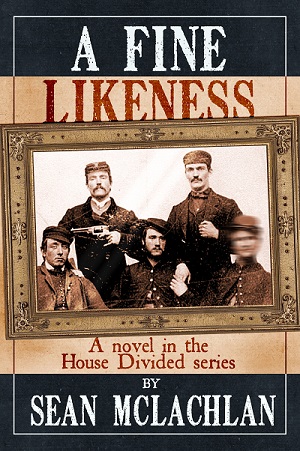
Home to author Sean McLachlan and the House Divided series of Civil War horror novels. A Fine Likeness, the first in the series, is available now. This blog is dedicated to the Trans-Mississippi Civil War and historical fiction, and occasionally veers off into adventure travel when I go somewhere interesting.
Looking for more from Sean McLachlan? He also hangs out on the Midlist Writer blog, where he talks about writing, adventure travel, caving, and everything else he gets up to. He also reproduces all the posts from Civil War Horror, so drop on by!
Showing posts with label world war one. Show all posts
Saturday, August 8, 2015
The Rat Killer and other Weird War Tales out now!
My latest short story collection, The Rat Killer and other Weird War Tales, is out now on Amazon and Smashwords. It's going through the Smashwords system of Premium distribution and will soon be available in all major online retailers. The cover is, as usual, done by my talented brother-in-law Andrés. It looks a bit different form his regular stuff and I think it works well. The book retails for $2.99. A blurb is below.
A rat hunter on the Western Front suspects his prey are plotting against him…
A routine trip through the trenches leads to an unexpected insight…
A soldier discovers the most dangerous enemy can't be killed…
A bereaved woman performs a forbidden ritual to avenge her father’s murder…
A doomed militia is offered a path to victory that leads to damnation…
Here are five tales of war from the pen of military historian and novelist Sean McLachlan. From the bushwhackers of the American Civil War to the trenches of WWI, these stories walk the line from the strange and paranormal to the frighteningly real.
Labels:
Civil War fiction,
ebook,
ebooks,
fiction,
First World War,
horror,
Kindle,
Kindle Direct Publishing,
new releases,
Sean McLachlan,
short stories,
Smashwords,
war,
world war one,
WWI
Sunday, July 26, 2015
Get my ebooks for 50% off!
Over at Smashwords I'm participating in their great summer/winter sale. Whether you're sweltering in the summer of the Northern Hemisphere, or chilling out somewhere south of the Equator, it's always a good time to read an ebook. Through July 31, all my ebooks at Smashwords are 50% off. You can see an entire list on my Smashwords page.
The books include my Trench Raiders World War One action series, each now $1.50; older works such as the short story collection The Night the Nazis came to Dinner and the historical fantasy The Quintessence of Absence, both $1.50; and my Civil War horror novels A Fine Likeness and The River of Desperation.
Use the coupon code SSW50 at checkout to save 50%!
Labels:
A Fine Likeness,
alternative history,
Civil War,
First World War,
historical fantasy,
historical fiction,
history,
horror,
The River of Desperation,
Trench Raiders,
world war one,
WWI
Tuesday, November 25, 2014
My new WWI novel now available for preorder!
My latest World War One action novel, Digging In, is coming out December 5 and is available for preorder. The story takes up where Trench Raiders
left off and continues the adventures of Crawford, Willoughby, and
Thompson, while introducing some interesting new characters. Here's the
blurb.
October 1914: The British line is about to break.
After two months of hard fighting, the British Expeditionary Force is short of men, ammunition, and ideas. With their line stretched to the breaking point, aerial reconnaissance spots German reinforcements massing for the big push. As their trenches are hammered by a German artillery battery, the men of the Oxfordshire and Buckinghamshire Light Infantry come up with a desperate plan--a daring raid behind enemy lines to destroy the enemy guns, and give the British a chance to stop the German army from breaking through.
Digging In is the second in a new series of World War One action novels that will follow the brave men of the BEF through the major battles of the First World War a hundred years after they happened. The Battle of Ypres was the first of many great slaughters on the Western Front, and it was there that both sides learned the true horror of the world's first global conflict.
It's now available on Amazon, Amazon UK, and all the other Amazons. It's also available on Smashwords and will soon be at all other major ebook outlets.
(By the way, if you're still following this blog, head on over to Midlist Writer, that's far more active)
October 1914: The British line is about to break.
After two months of hard fighting, the British Expeditionary Force is short of men, ammunition, and ideas. With their line stretched to the breaking point, aerial reconnaissance spots German reinforcements massing for the big push. As their trenches are hammered by a German artillery battery, the men of the Oxfordshire and Buckinghamshire Light Infantry come up with a desperate plan--a daring raid behind enemy lines to destroy the enemy guns, and give the British a chance to stop the German army from breaking through.
Digging In is the second in a new series of World War One action novels that will follow the brave men of the BEF through the major battles of the First World War a hundred years after they happened. The Battle of Ypres was the first of many great slaughters on the Western Front, and it was there that both sides learned the true horror of the world's first global conflict.
It's now available on Amazon, Amazon UK, and all the other Amazons. It's also available on Smashwords and will soon be at all other major ebook outlets.
(By the way, if you're still following this blog, head on over to Midlist Writer, that's far more active)
Labels:
Digging In,
ebook,
ebooks,
First World War,
historical fiction,
Kindle,
Kindle Direct Publishing,
military history,
Sean McLachlan,
Smashwords,
Trench Raiders,
war,
world war one
Friday, August 8, 2014
Trench Raiders now available!
Just in time for the WWI centenary, I've come out with Trench Raiders, the first in a series of World War one action novels. Here's the blurb:
September 1914: The British Expeditionary Force has the Germans on the run, or so they think.
After a month of bitter fighting, the British are battered, exhausted, and down to half their strength, yet they’ve helped save Paris and are pushing toward Berlin. Then the retreating Germans decide to make a stand. Holding a steep slope beside the River Aisne, the entrenched Germans mow down the advancing British with machine gun fire. Soon the British dig in too, and it looks like the war might grind down into deadly stalemate.
Searching through No-Man’s Land in the darkness, Private Timothy Crawford of the Oxfordshire and Buckinghamshire Light Infantry finds a chink in the German armor. But can this lowly private, who spends as much time in the battalion guardhouse as he does on the parade ground, convince his commanding officer to risk everything for a chance to break through?
Trench Raiders is the first in a new series of World War One action novels that will follow the brave men of the British Expeditionary Force through the major battles of the First World War a hundred years after they happened. The Battle of the Aisne was the start of trench warfare on the Western Front, and it was there that the British and Germans first honed their skills at a new, vicious brand of fighting.
Trench Raiders is available at Amazon, Smashwords, and within a few days will be available at all other online outlets.
September 1914: The British Expeditionary Force has the Germans on the run, or so they think.
After a month of bitter fighting, the British are battered, exhausted, and down to half their strength, yet they’ve helped save Paris and are pushing toward Berlin. Then the retreating Germans decide to make a stand. Holding a steep slope beside the River Aisne, the entrenched Germans mow down the advancing British with machine gun fire. Soon the British dig in too, and it looks like the war might grind down into deadly stalemate.
Searching through No-Man’s Land in the darkness, Private Timothy Crawford of the Oxfordshire and Buckinghamshire Light Infantry finds a chink in the German armor. But can this lowly private, who spends as much time in the battalion guardhouse as he does on the parade ground, convince his commanding officer to risk everything for a chance to break through?
Trench Raiders is the first in a new series of World War One action novels that will follow the brave men of the British Expeditionary Force through the major battles of the First World War a hundred years after they happened. The Battle of the Aisne was the start of trench warfare on the Western Front, and it was there that the British and Germans first honed their skills at a new, vicious brand of fighting.
Trench Raiders is available at Amazon, Smashwords, and within a few days will be available at all other online outlets.
Labels:
First World War,
Kindle,
Kindle Direct Publishing,
military history,
Sean McLachlan,
Trench Raiders,
war,
world war one
Friday, February 28, 2014
Military History Photo Friday: Senegalese Troops in World War One
Hello from Tangier! Actually I'm writing this several days early and scheduling it ahead of time because I'm happily without Internet for a few days so my better half and I can enjoy our 14th anniversary in the Casbah.
To keep with the African theme, here's a photo of the Tirailleurs Sénégalais in World War One. What is now Senegal was a French colony during the war and like many other colonies they sent troops. Senegalese fought with distinction throughout the war on both the Western Front and the Dardanelles.
Recruits also came from Morocco, Indochina, and other colonies. More than 72,000 colonial soldiers died during the war.
Below is a closeup of the middle two guys with their flag commemorating some of the battles they fought in. You can see they've earned some medals too.
Photo courtesy Wikimedia Commons.
To keep with the African theme, here's a photo of the Tirailleurs Sénégalais in World War One. What is now Senegal was a French colony during the war and like many other colonies they sent troops. Senegalese fought with distinction throughout the war on both the Western Front and the Dardanelles.
Recruits also came from Morocco, Indochina, and other colonies. More than 72,000 colonial soldiers died during the war.
Below is a closeup of the middle two guys with their flag commemorating some of the battles they fought in. You can see they've earned some medals too.
Photo courtesy Wikimedia Commons.
Labels:
Africa,
First World War,
history,
military history,
Military History Photo Friday,
Sean McLachlan,
world war one
Saturday, February 15, 2014
Book Review: The First World War: Germany and Austria-Hungary 1914-1918
The First World War: Germany and Austria-Hungary 1914-1918 by Holger H. HerwigMy rating: 5 of 5 stars
The popular academic study of World War One in English has long suffered a deficit in the number of publications that use German sources. Herwig's hefty tome comes as a welcome change to this. At 450 dense pages, only serious history buffs need apply.
Those willing to make the effort, however, will find their understanding of the war enriched and changed. While we are long accustomed to hearing criticisms of the Entente's General staff, the commanders of the Central Powers are shown to have made many key blunders and to be grossly out of touch with the reality on the ground.
Herwig goes through each year and campaign in detail, backed up with a wealth of primary sources. I could have used some more personal accounts--the ones he gives are gripping--but that's not really the focus here. He shows how the high command was influenced by politics, posturing, and unrealistic expectations. The incapacity of the Austro-Hungarian Empire to wage war is well drawn, and Herwig knows just when to bring out a telling detail. For example, rubber was in such shortage that in 1917 the Hapsburg government requisitioned the pockets from all billiard tables!
Herwig takes us step by step through the evolving political, strategic, and tactical situations. A glossary of terms and key figures and some more detailed maps would have been helpful, but I can't bring myself to give this book fewer than five stars. It's essential reading for anyone who wants to truly understand the Great War in detail.
View all my reviews
Labels:
book review,
book reviews,
First World War,
Goodreads,
history,
military history,
Sean McLachlan,
war,
world war one
Friday, February 7, 2014
Military History Photo Friday: Beating Shells Into Drinking Cups
Why beat swords into plowshares when you can turn an artillery shell into a drinking cup? That's what one soldier did in World War One. Actually it was a fairly common practice and was part of a larger movement called Trench Art. When they weren't busy killing each other, stringing barbed wire, or hunting rats, soldiers took time out to express themselves. The detritus of war such as shell casings often provided the material.
These were done by a French soldier and bear the names Tahure and Hurlus, two villages near the Marne that were destroyed in the war and never rebuilt. You might also be interested in a German photo album from World War One that's just been published. Click the link for some gripping images.
Oh, and I'm over at Sioux's Page today talking about Writing About Women When You're a Man. Drop on by!
Image courtesy Wikimedia Commons.
Labels:
artillery,
First World War,
military history,
Military History Photo Friday,
Sean McLachlan,
world war one
Friday, January 24, 2014
Military History Photo Friday: Romania Defeated in World War One
This is an Austro-Hungarian propaganda poster from 1916 celebrating the defeat of Romania. That year Romania joined the allies fighting Germany and Austro-Hungary on the promise of territorial gains. Their army was woefully out-of-date, however, and a quick offensive by the Central Powers crushed them.
Here a German and Autro-Hungarian soldier are celebrating a round as the prisoners come racing in. In reality both armies had supply shortages by this time. The Austro-Hungarian soldier would have been dressed in tattered clothing and neither would have been drinking beer unless they had plundered it from some Romanian village.
The defeated army is interesting too. Not only does it show Romanian soldiers (who surrendered in droves, often not having fired a shot) and their Russian allies but also British and even a Colonial Sikh soldier. Well, there's nothing like a good bit of propaganda!
An interesting footnote to this campaign is that a young German Lieutenant named Erwin Rommel distinguished himself during the fighting. He wrote an excellent analysis of the campaign. I've read it, but I can't seem to find it online. Any university library should have it, though. It's considered a classic.
Photo courtesy Wikimedia Commons.
Here a German and Autro-Hungarian soldier are celebrating a round as the prisoners come racing in. In reality both armies had supply shortages by this time. The Austro-Hungarian soldier would have been dressed in tattered clothing and neither would have been drinking beer unless they had plundered it from some Romanian village.
The defeated army is interesting too. Not only does it show Romanian soldiers (who surrendered in droves, often not having fired a shot) and their Russian allies but also British and even a Colonial Sikh soldier. Well, there's nothing like a good bit of propaganda!
An interesting footnote to this campaign is that a young German Lieutenant named Erwin Rommel distinguished himself during the fighting. He wrote an excellent analysis of the campaign. I've read it, but I can't seem to find it online. Any university library should have it, though. It's considered a classic.
Photo courtesy Wikimedia Commons.
Labels:
Austria,
First World War,
Germany,
history,
military history,
Military History Photo Friday,
Sean McLachlan,
world war one
Wednesday, January 22, 2014
Movie Review: The Red Baron (mild spoilers)
I don't usually post movie reviews on this blog, but since I'm on a World War One kick as I'm preparing to start my Trench Raiders series, I've been doing a lot of reading and watching some WWI films.
The Red Baron came out in 2008 and I've been wanting to see it ever since. This week I finally got my chance and I have to say I was disappointed. Matthias Schweighöfer played Manfred von Richthofen and did a flat and uncharismatic performance. The supporting actors were equally unimpressive.
I could have forgiven this if the script were better, but this is where the film really falls down. Despite being two hours long, the movie is jumpy and episodic, often becoming a bit confusing. It was like a real movie stuck on fast forward with some of the scenes missing.
And the missing scenes were the most important, like the dog fight where the Red Baron suffered his head injury and also the final dogfight that ended in his death. They also skipped the epic dogfight between Lt. Werner Voss and eight British aircraft. Instead they added a fictitious love interest between Richthofen and a nurse that came out insipid and smacking of daytime television.
It's a real shame that they cut down on the action scenes because the two aerial battles they do show are brilliantly done, some of best action sequences on film. Why, in a film about a flying ace, are there so few of them?
Then there are the historical inaccuracies, like Richthofen and Canadian pilot Capt. Roy Brown meeting for a friendly drink in No Man's Land, the love interest, heaps of anachronisms, and Richthofen developing pacifistic ideals and the hint that he let himself get shot down in order to hasten the end of the war. Um, no.
This movie gets two out of five stars. Hopefully some better director with a better script will step forward and give us a Red Baron movie worthy of the name.
The Red Baron came out in 2008 and I've been wanting to see it ever since. This week I finally got my chance and I have to say I was disappointed. Matthias Schweighöfer played Manfred von Richthofen and did a flat and uncharismatic performance. The supporting actors were equally unimpressive.
I could have forgiven this if the script were better, but this is where the film really falls down. Despite being two hours long, the movie is jumpy and episodic, often becoming a bit confusing. It was like a real movie stuck on fast forward with some of the scenes missing.
And the missing scenes were the most important, like the dog fight where the Red Baron suffered his head injury and also the final dogfight that ended in his death. They also skipped the epic dogfight between Lt. Werner Voss and eight British aircraft. Instead they added a fictitious love interest between Richthofen and a nurse that came out insipid and smacking of daytime television.
It's a real shame that they cut down on the action scenes because the two aerial battles they do show are brilliantly done, some of best action sequences on film. Why, in a film about a flying ace, are there so few of them?
Then there are the historical inaccuracies, like Richthofen and Canadian pilot Capt. Roy Brown meeting for a friendly drink in No Man's Land, the love interest, heaps of anachronisms, and Richthofen developing pacifistic ideals and the hint that he let himself get shot down in order to hasten the end of the war. Um, no.
This movie gets two out of five stars. Hopefully some better director with a better script will step forward and give us a Red Baron movie worthy of the name.
Labels:
First World War,
Germany,
history,
military history,
movie review,
Sean McLachlan,
world war one
Sunday, January 19, 2014
My next work in progress: Trench Raiders
Right now I'm busy with preparations for releasing Radio Hope on February 1 and the accompanying virtual book tour. I'm also writing the sequel--Book Two in the Toxic World series, Refugees from the Righteous Horde.
After that, I'll be starting another series, Trench Raiders. These will be action books set in World War One along the lines of Jack Badelaire's excellent Commando series of WWII books. It follows a group of British soldiers as they become a crack trench raiding unit. The first book takes place at the Battle of Aisne in September 1914, the first time that the British Expeditionary Force faced German trenches.
As you might expect, the British got slaughtered, and this is where our heroes come in. They realize that frontal charges across No-Man's Land aren't going to work and so they develop their own techniques. I'm in the midst of researching the battle right now and came across this Wikimedia Commons image of an old German novel titled Hell Fights at the Aisne River. Cool image, but I won't be using it for my own cover. I want a British soldier, not a German one!
The plan is to alternate between my post-apocalyptic Toxic World series and the Trench Raiders series. I also have some stand-alone works simmering in the back of my mind. This year is going to be a busy one!
Friday, November 8, 2013
Military History Photo Friday: Crystal Radio in the Trenches
I'm hard at work on my National Novel Writing Project--Radio Hope, a post-apocalyptic tale. I'm proud to say that I've passed the 20,000 word mark in just a week. December will be National Typo Correcting Month!
My story revolves around the residents of New City, the only large settlement in a toxic wasteland filled with bandits, scavengers, insane chemical sniffers, and bloodthirsty cultists. One of the few sources of information is Radio Hope, a mysterious station broadcasting programs about medicine, agriculture, food gathering, and other survival tips.
No one knows where this station transmits from or who's behind it. Since you need electricity to operate a radio, only a lucky few can receive its transmissions, until a mysterious trader emerges from the wildlands with a supply of crystal radios.
Crystal radios were the first popular radios. They rely on a crystal detector to pick up radio signals. The crystal uses the energy from the radio waves themselves to power the radio, so no electricity supply is necessary. In the 1920s store-bought radios were expensive and many rural homes still lacked electricity. It was cheap and simple to build a crystal set, though, and soon most homes had one, leading to the boom in radio.
In this image you can see a French soldier in the trenches during World War One listening to a handmade set. I wonder what he was listening to? An opera from back in Paris?
Image courtesy Wikimedia Commons.
Friday, August 2, 2013
Military History Photo Friday: the A7V, Germany's only tank in World War One
This cumbersome beast is the A7V, a German tank from World War One. It looks like something my seven-year-old son would design. "Look Papa, it's got a cannon on the front and machine guns sticking out the windows here and I made it from a cardboard box!"
While the Germans had the most advanced tanks in the world during WWII, this was not the case in WWI. They got into tank building in 1917, well after the UK and France already had large numbers of tanks. By then German industry was starved of raw material and only twenty ever got made.
The A7V had 30mm thick armor at the front and thinner armor on the sides and top. It weighed 33 tons and had a low undercarriage. It was so unwieldy it often lagged so far behind the infantry that it never got into the fighting. It also had the bad habit of getting stuck in trenches and shell holes.
Despite these shortcomings, its cannon and six machine guns made it effective in a fight. The few times these tanks were deployed they often took Allied forces by surprise. The Allies weren't expecting the Germans to have tanks. An even nastier surprise was when the Germans used captured British Mark IVs, like the one shown below with German markings!
While the Germans had the most advanced tanks in the world during WWII, this was not the case in WWI. They got into tank building in 1917, well after the UK and France already had large numbers of tanks. By then German industry was starved of raw material and only twenty ever got made.
The A7V had 30mm thick armor at the front and thinner armor on the sides and top. It weighed 33 tons and had a low undercarriage. It was so unwieldy it often lagged so far behind the infantry that it never got into the fighting. It also had the bad habit of getting stuck in trenches and shell holes.
Despite these shortcomings, its cannon and six machine guns made it effective in a fight. The few times these tanks were deployed they often took Allied forces by surprise. The Allies weren't expecting the Germans to have tanks. An even nastier surprise was when the Germans used captured British Mark IVs, like the one shown below with German markings!
Friday, May 24, 2013
Military History Photo Friday: Hemingway at the front
Hello from Gorizia, where I'm a guest speaker at the èStoria annual history festival. Today Gorizia is on the Italian-Slovenian border, but during World War One it was on the border between Italy and the Austro-Hungarian Empire. It was the scene of some of the fiercest fighting of the war.
Just east of Gorizia flows the Isonzo River, and to the east of the river rise steep mountains. Go a little north of here and there are mountains on both sides of the river. Both armies wanted to advance, but that meant crossing an exposed valley to storm entrenched positions on usually steep terrain. Mostly it was the Italians trying to push east, again and again. There wasn't just one Battle of Isonzo, there were twelve.
Most were utter failures leading to heavy loss of life. Only during the sixth Battle of Isonzo did the Italians actually make any significant gains, and then they lost it all and more in battle #12, also known as the Battle of Caporetto. It was this battle that Ernest Hemingway immortalized in A Farewell to Arms. Hemingway was an ambulance driver for the Red Cross. Here he is, young and unknown.
This painting by R.A. Höger (1873-1930) shows some of the fierce fighting between the Austro-Hungarians and the Italians on a front that is rarely discussed in the English speaking world. Tomorrow I'm touring the battlefield. Stay tuned for a full article!
Images courtesy Wikimedia Commons.
Labels:
history,
Italy,
military history,
Military History Photo Friday,
photography,
Sean McLachlan,
travel,
war,
world war one
Subscribe to:
Posts (Atom)