Looking for more from Sean McLachlan? He also hangs out on the Midlist Writer blog, where he talks about writing, adventure travel, caving, and everything else he gets up to. He also reproduces all the posts from Civil War Horror, so drop on by!

Friday, July 29, 2011

Civil War Photo Friday: Brothers off to war

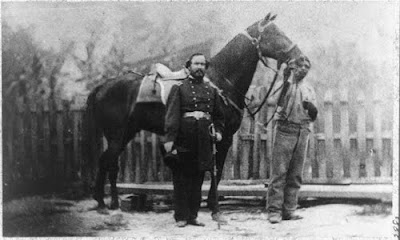
When looking for cover art for my novel at the Library of Congress website I came across this fine photo. It didn't work as a cover shot but it struck me as powerful so I'm reproducing it here.

Sadly there's no information on who these two were although it's obvious they were brothers. They certainly look ready for a fight, especially the guy on the right. He's got a proper six-shooter rather than a one-shot dragoon pistol. No wonder he looks more confident! Dragoon pistols were fairly common at the beginning of the war but were soon dispensed with as being inferior and outdated weapons. When Captain Richard Addison goes on a shopping spree in my novel, he buys every pistol he can except dragoon pistols. Going up against Bloody Bill Anderson he needs proper firepower!

As you can see, the photo has been colorized by hand painting, a popular technique back then to give a little more realism to black and white images. If anyone out there has a photo of a Civil War ancestor I'd love to share it with the world. Drop me a line!

Wednesday, July 27, 2011

Ebook pricing

I've been thinking about what price to set for A Fine Likeness. It's a full-length novel at 95,000 words (about 380 printed pages) yet as an ebook it's not as much of a "product" as a print book. I feel the big publishers are wrong to price ebooks the same as their print volumes since you can't give it away, resell it or, according to Amazon's rules, really even own it.

In my discussion of why I chose Kindle Direct Publishing, I said that I was going to price it at $2.99, the minimum to get 70% royalties. Factoring in Amazon's 15 cent "delivery fee", this works out to $1.943 profit per copy. I’d need to sell 2,573 copies to make $5,000, the average advance for a first-time genre author.

Two recent posts by fellow professionals have made me rethink. Zoe Winters writes about the 99 Cent Ghetto, in which she lambasts the popular move to price self-published ebooks at 99 cents. She says this author-driven phenomenon is cheapening what we authors do. I agree. Marketing people talk about "perceived value." If something looks too cheap, it probably is. Just watch the average buyer in a wine shop. Beyond the simple decision of red vs. white, a lot of people simply buy by price. Hot date? Get the $20 bottle. Making sangria? Get the $5 bottle. Bad comparison? Maybe, but you see my point.

Dean Wesley Smith also does the math on the Great 99 Cent Debate and proves it's almost impossible to make decent money by pricing your book at 99 cents.

So I think I'm going to price A Fine Likeness at $4.99. With 70% royalties minus the delivery fee that nets me $3.343 per copy. I need to sell 1,496 copies to make $5,000 instead of 2,573 copies. If I do sell my original target of 2,573 copies, I'll make $8.601.54. Nice!

Some Kindle authors will say I'm pricing myself out of the market. I don't think so. If someone is attracted to my book, they'll pay $4.99 as readily as $2.99. It's half the price of a print book, after all. Even if I do lose a few potential buyers, I think the increased revenue per copy will more than make up for it.

So, what do you think?

Tuesday, July 26, 2011

Version 2.0 for my cover

Last week I posted the first version of the cover for my Civil War horror novel, A Fine Likeness. Many of you fine folks gave good advice here and on the Kindle Direct Publishing forum. Here's version 2.0. The one thing that will certainly change is that "House Divided" will be capitalized since that's the series title. My brother-in-law doesn't speak much English so I think he missed that. What do you think of this new version?

Monday, July 25, 2011

The first Confederate invasion of the North!

In covering all things Trans-Miss on this blog, I'd be remiss if I didn't mention that this week marks the 150th anniversary of the first Confederate invasion of the Union, which happened in the western fringes of the Trans-Mississippi at Mesilla, New Mexico Territory, across the Rio Grande from Texas.

The story of this historic, albeit small, invasion is being told on an excellent blog called Civil War Daily Gazette. Rather than steal the Gazette's thunder, I'll simply direct you over there. This brave blogger has vowed to blog every day of the Sesquicentennial and his efforts should be rewarded with a hit counter as big as the National Debt Clock.

The fourth book in my House Divided series will be taking place in the New Mexico and Arizona Territories before, during, and after Sibley's ill-fated attempt to take the Far West for the Confederacy. I lived in Tucson for twelve years, not far from the westernmost battle of the Civil War at the Battle of Picacho Peak, so I have a deep interest in this aspect of the war.

[Photo of Confederate flag raising over Tucson courtesy Wikimedia Commons]

Friday, July 22, 2011

Civil War Photo Friday: A Union officer and his slave

This photo shows Col. Madison Miller of the 18th Missouri Infantry, a Union regiment. The 18th Missouri served in its own state until March 1862, when like many other Tran-Mississippi units, both North and South, it was transferred east of the river, where it stayed until the end of the war. Miller was declared missing at the Battle of Shiloh. Considering the carnage of that battle, he was probably killed and his body never recovered.

The man holding his horse may have been a slave. Since Missouri was not considered a state in rebellion, Lincoln’s 1863 Emancipation Proclamation didn’t apply to it. Slaves were not freed in Missouri until a state convention freed them on 11 January 1865. Despite this, Missouri formed its first Negro regiment in 1863, made up of free blacks and runaways from Arkansas. A total of 8,300 blacks served in Missouri units, although it's unclear how many of them were actually Missourians.

Wednesday, July 20, 2011

A Fine Likeness gets a cover!

My brother-in-law Andrés has designed a cover for my Civil War horror novel A Fine Likeness. It incorporates a photo I got off the Library of Congress archive. I didn't find this photo until a couple of years after I wrote the scene and was blown away that these guys are posed almost exactly as Jimmy's band of bushwhackers were posed when they got their photo taken. The only difference is that in the book there are six people, while in this photo there are only five. But hey, how often do covers exactly match what's inside the book?

What do you think of this design? I'd like to hear your opinion!

Monday, July 18, 2011

Making character quirks part of the plot

If you're writing fiction, one of the challenges is to make your characters well-rounded and believable. One way to do this is with quirks, the strange little habits and idiosyncrasies that we all have and our characters should have to make them seem real. Quirks can tell a lot about a person, or may simply be another identifier so the reader can follow the action in a crowded scene. Quirks can even have some greater symbolism.

In my Civil War horror novel A Fine Likeness, one of my main characters is fifty-year-old Captain Richard Addison of the Enrolled Missouri Militia. Now anyone who has read up on the Civil War in Missouri knows this Union militia got their butts kicked on a regular basis. Well, this guy is no exception, especially in the beginning of the book. He has two main quirks--he loves riding and he gets lower back pain any time he rides for long periods of time. Getting old, you see. The war has worsened this condition because he's in the saddle most of every day. Our hero is losing the enjoyment of his favorite activity because of a war he hates.

This isn't a major part of the plot or even particularly important to it, although it does put him in a foul mood much of the time. What it does do is give symbolic example of the weakness of the Union militia and highlight our hero's dislike of the conflict.

Another quirk Captain Addison has is that he strokes his beard when he's thinking, a common practice among bearded men for some reason. After a few repetitions of this action the reader knows that Addison is mulling over something when he strokes his beard.

So when you're writing up characters, try to think of some quirks. It makes the reading, and the writing, a lot more fun.