Here's a strange gun that saw a fair amount of use in the Confederate army.
Called the LeMat pistol, it was patented in 1856 by Jean Alexandre LeMat of New Orleans. It featured a nine-shot cylinder, rifled barrel, and a smoothbore shotgun underneath. This was fired by a pivoting striker on the hammer that could be rotated so that it struck a percussion cap on the lower barrel, thus firing the buckshot.
The advantages of this pistol over regular six-shooters is obvious. Reloading black powder weapons is a slow business and not at all fun in the middle of a battle. Many bushwhackers compensated by carrying more than one pistol, or extra loaded cylinders that could be snapped into place. Extra guns or cylinders weren't always available, however, especially to regular army units, so having more shots in the same gun came in handy.
One disadvantage of the gun was that revolver part originally fired .35, .40, or .42 bullets, all nonstandard sizes. Quartermasters had to stock special bullets or the troops were forced to cast their own. Later versions were made to fire .36 or .44 caliber bullets, the standard for both Union and Confederate armies.
New Orleans was captured early in the war and LeMat fled to France, where he had his special guns produced by French, Belgian, and English manufacturers. About 3,000 slipped through the Union blockade to make it into the hands of rebel troops.
I have found no record of these weapons seeing service west of the Mississippi so they won't be featuring in my next Missouri Civil War novel. I do have plans to write some Westerns some day and I probably won't be able to resist the urge to outfit at least one character with a LeMat!
Here's a look at the business end of this fearsome weapon. I took both photos at the Pitt-Rivers Museum in Oxford. For more on this interesting gun check out this website by some Florida Reenactors.
Home to author Sean McLachlan and the House Divided series of Civil War horror novels. A Fine Likeness, the first in the series, is available now. This blog is dedicated to the Trans-Mississippi Civil War and historical fiction, and occasionally veers off into adventure travel when I go somewhere interesting.
Looking for more from Sean McLachlan? He also hangs out on the Midlist Writer blog, where he talks about writing, adventure travel, caving, and everything else he gets up to. He also reproduces all the posts from Civil War Horror, so drop on by!
Tuesday, July 31, 2012
The LeMat Combination Revolver/Shotgun
Labels:
black powder,
Civil War,
Civil War weapons,
history,
military history,
war,
weapons
Monday, July 30, 2012
Book Review: The Lyon Campaign in Missouri
An excellent first-person account by a "90 day volunteer" in the early days of the fight for Missouri. He covers the years leading up to the war and includes lots of interesting anecdotes about life in Iowa back then. There's not much fighting in this book, but you get a good look at the daily misery of the soldiers with their bad or sometimes nonexistent rations, hard marches, adverse weather, and incompetent officers. A must-read for anyone interested in a private's eye view of war in the Trans-Miss.
I read the free version on Google Books. Google has scanned many public domain books and while the price is right (free) they have done no editing. While it's a treasure trove of otherwise hard-to-find titles, the books aren't the best reading quality. Often the scanner makes mistakes with these old books because of faded type and creased pages. At times there are obvious typos and occasionally complete gibberish. I'm almost tempted to shell out for the Camp Pope edition just to have this fine title on my shelf.
Labels:
book review,
book reviews,
Civil War,
Civil War Missouri,
ebook,
ebooks,
history,
military history,
Missouri,
Missouri history,
Ozarks,
Ozarks Civil War,
Trans-Miss,
Trans-Mississippi Theater,
war
Sunday, July 29, 2012
A writing podcast worth listening to
Longtime writing buddy and fellow traveler Cynthia Hope Clark is the guest on the latest episode of the What the Glass Contains podcast. She reads from her novel Lowcountry Bribe and gives some great advice on writing. One of my favorite points is that the more you write, the better you get. Don't sweat it, just practice. Seems like a no-brainer, but a lot of writers need to be reminded of that. Head on over and have a listen! Also check out the guest post she did on history as the foundation of any novel.
Labels:
author interview,
fiction,
writing,
writing advice,
writing tips
Saturday, July 28, 2012
My new travel series: Exploring Orkney: Scotland's Rugged Northern Isles
As I mentioned earlier, I spent a week in the Orkney Islands exploring the archaeological and natural wonders there. I've started a series over at Gadling called "Exploring Orkney: Scotland's Rugged Northern Isles." There's lots of good photos and information about this region's unique prehistory and folklore. Should be inspiring for writers and travelers alike. Check it out!
Labels:
about me,
adventure travel,
Gadling,
Scotland,
travel,
travel writing
Friday, July 27, 2012
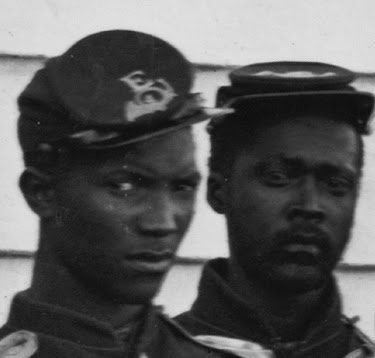
Civil War Photo Friday: The Faces of Black Soldiers
This photo has been published a lot. It shows Company E of the 4th U.S. Colored Infantry, at Fort Lincoln, District of Columbia, and is freely available from the Library of Congress.
I love the faces in this photo with all their individual expressions and characters, so I downloaded the 86 megabyte version and zoomed in on some of the individuals.
The tall fellow in the center caught my attention first. . .
. . .then I noticed this determined man near him.
Others look warily at the camera. . .
. . .while others seem more relaxed. . .
. . .or even a bit amused at what's probably their first photo shoot.
The Library of Congress has thousands of hi-res images of the Civil War and other periods. Check them out to see some faces from the past!
Thursday, July 26, 2012
Writing Pitfall #2: Talking More Than Writing
Let's face it--writers are full of themselves. How else could we assume that people will actually pay to read the products of our thoughts and imagination? It's a pretty big assumption.
So being a bit arrogant is actually part of the muse, but one flaw I see in a lot of beginning writers is that they spend more time talking about being a writer than actually writing. They boast to all their friends about the great novel they're working on, when in fact they haven't made it past page ten after five months of "work". They get into flame wars on newsgroups, arguing about all the tired controversies that crop up continually in such places, when they should be saving that energy for their writing.
My advice--shut up and write!
Yes, this blog counts as talking about writing, but I spend about sixty hours a week writing, researching, editing, or pitching, so I've earned the right to gab a bit. :-)
Cynthia Hope Clark talked about this on her blog recently, along with other common mistakes. She makes the point that you can end up diluting the creative process if you talk about your work in progress too much.
Wednesday, July 25, 2012
The Civil War adventures of James Earp
James Earp was the older brother of famous lawman Wyatt Earp. He never earned the fame of his gunslinger brother, or even the lesser notoriety of Virgil and Morgan Earp. Jim, as most people called him, worked as a saloon keeper in Tombstone but didn't participate in the Gunfight at the OK Corral or the subsequent Vendetta Ride.
I never knew much about him until I started writing a book on the Earps for Osprey Publishing, due out in 2013. It turns out Jim saw service in Missouri during the Civil War. When the war started, he enlisted in the 17th Illinois Infantry, a Union outfit that soon marched into war-torn Missouri.
On October 21, the 17th Illinois saw its first major action at the Battle of Fredericktown in southeast Missouri. Confederate General "Swamp Fox" Thompson was in the area with 1500 men and had burnt an important railroad bridge. The 17th Illinois and some other units went after him.
Thompson placed his rebels along a wooded ridge overlooking the road on which the Union troops were approaching. A smaller detachment with three cannon stood in plain view in a cornfield next to the road as bait. The Union column arrived and attacked the Confederates in the cornfield. The 17th Illinois advanced on the enemy center as two other units attacked either flank. After some heavy fighting, the rebels retreated, but the Union troops soon came under a galling fire from the rebels hidden on the ridges.
Despite this, Thompson saw he was outnumbered about two-to-one and that he needed to withdraw. The 17th Illinois managed to capture one of the cannons in the cornfield, an old iron 12-pounder that was out of date, although not as rickety as the wooden cannon used at another battle in Missouri!
Being in the thick of the fight, the 17th Illinois suffered several casualties. One of them was James Earp. He took a bullet in the shoulder that crippled his left arm for life. He was invalided out and spent the rest of the war recovering and working various jobs. He joined his brothers in Tombstone in 1879, where the family gained their place in history. James died in California in 1926.
Numerous online sources say he was wounded on October 31, but the battle was in fact on October 21 and I cannot find any record of a battle involving the 17th Illinois for October 31. I suppose, then, that he was wounded at the actual Battle of Fredericktown and not some skirmish ten days later. I could be wrong, though. I'm in England at the moment and away from my collection of Civil War books!
Two other Earp brothers, Virgil and Newton, also enlisted in the Union army. I'll try to find out more about their experiences for future posts.
Photo courtesy Wikimedia Commons.
Labels:
Arizona,
Civil War,
Civil War battles,
Civil War Missouri,
history,
military history,
Missouri,
Missouri history,
Old West,
Osprey Publishing,
Wild West
Subscribe to:
Posts (Atom)